
Cheapest Way to Ship a Bike (2025): Costs, Tips & Options
So, you need to get your bike from point A to point B without breaking the bank. Whether you’re moving, selling a bike online, or heading to a race, finding the cheapest way to ship a bike can feel like a puzzle. For most domestic shipments, using a dedicated bike shipping service like BikeFlights is the cheapest way to ship a bike. However, if you’re flying, checking your bike as luggage can be even more affordable if you stay under the airline’s size and weight limits. You have to think about packing, weight, dimensions, and which company to trust. Don’t worry, it’s easier than it looks. This guide will walk you through everything you need to know to make smart, cost effective choices.
Comparing Your Main Options for Bike Shipping
Before we get into the details, let’s look at the primary methods for shipping your bike. The cheapest way to ship a bike often comes down to one of these choices, depending on your situation.
1. Use a Dedicated Bike Shipping Service
For many cyclists, this is the gold standard. Specialized companies like BikeFlights or ShipBikes.com have partnerships with major carriers like UPS and FedEx. Because they ship in high volume, they get access to significant discounts and pass those savings on to you.
Using a bike shipping service is frequently the cheapest way to ship a bike for domestic ground delivery. You can expect costs to be in the range of $60 to $120 for cross country travel, with delivery taking about five to nine days. They streamline the process by generating a discounted shipping label for you to print and attach to your boxed bike.
2. Take it on a Plane as Checked Baggage
Flying to your destination? Taking your bike with you as checked baggage can be surprisingly affordable. Many major airlines have changed their policies to be more cyclist friendly. For example, American Airlines and Alaska Airlines now treat a bicycle like any other standard checked bag. If your packed bike is under the 50 pound weight limit, you might only pay the standard bag fee, which is often around $35.
However, you have to be careful. If you go over the weight or size limits, the fees can get steep. While Delta also treats bikes as standard luggage and waives oversize fees, they charge an overweight fee starting at $100 for bags between 51 and 70 pounds. Budget airlines like Frontier might charge a flat $75 bike fee each way. Always check your specific airline’s policy before you head to the airport.
3. Ship Directly With a Carrier (UPS, FedEx, or USPS)
You can always walk into a UPS Store, FedEx Office, or Post Office to ship your bike. While convenient, this is rarely the cheapest way to ship a bike if you pay the full retail price at the counter. A cross country shipment using UPS Ground or USPS Ground Advantage at retail rates could run anywhere from $130 to $280.
For direct shipping, FedEx Ground is often a reliable and cost effective choice for large items like bikes. They can handle packages up to 150 lbs and 165 inches in length plus girth. The secret to saving money here is to access direct carrier shipping discounts. By creating an account online or using shipping software, you can get commercial rates that are much lower than what you pay at the counter.
Want to see these discounted rates for yourself? A great first step is to compare shipping rates online to see how the major carriers stack up for your specific shipment.
4. Use Consolidated Freight with a Household Move
If you are moving your entire household, shipping your bike separately might not be necessary. Moving companies that use consolidated freight can often include your bike with your other belongings. With this method, your items are combined with other shipments heading to a similar location, so you only pay for the space your goods occupy on the truck. This can be a very cost effective option, as the bike is just one part of a larger shipment. Be sure to ask your moving company if they offer this service and how they require the bike to be packed.
Real World Price Example: Shipping a Bike from NYC to LA
To make these numbers concrete, let’s compare the estimated costs of shipping a standard bike. We’ll use a common scenario: a 45 pound bike packed in a 54 x 8 x 28 inch box, traveling from New York City to Los Angeles.
| Shipping Service | Estimated Cost (Ground) | Key Considerations |
|---|---|---|
| BikeFlights | $85 to $110 | Often the cheapest overall. Leverages discounted UPS/FedEx networks. |
| Airline Checked Bag | $35 to $45 | The cheapest if you’re flying anyway and the bike is your first or second bag. |
| USPS Ground Advantage | $135 to $280 | Retail rates are high; commercial pricing offers savings but may still be pricier. |
| UPS Ground (Retail) | $130 to $230 | Paying at a UPS Store is expensive. Use their online portal for better rates. |
| FedEx Ground (Retail) | $130 to $200+ | Like UPS, retail counter rates are much higher than online commercial rates. |
Note: Prices are estimates for 2025 and can vary based on surcharges, insurance, and exact locations. Always compare real time quotes.
Preparing Your Bike for a Safe and Cheap Journey
How you pack your bike has a huge impact on the final cost. A smaller, lighter box is always cheaper.
Packing: Do It Yourself vs. Paying a Pro
You have two choices here: pack the bike yourself or pay a local bike shop to do it for you.
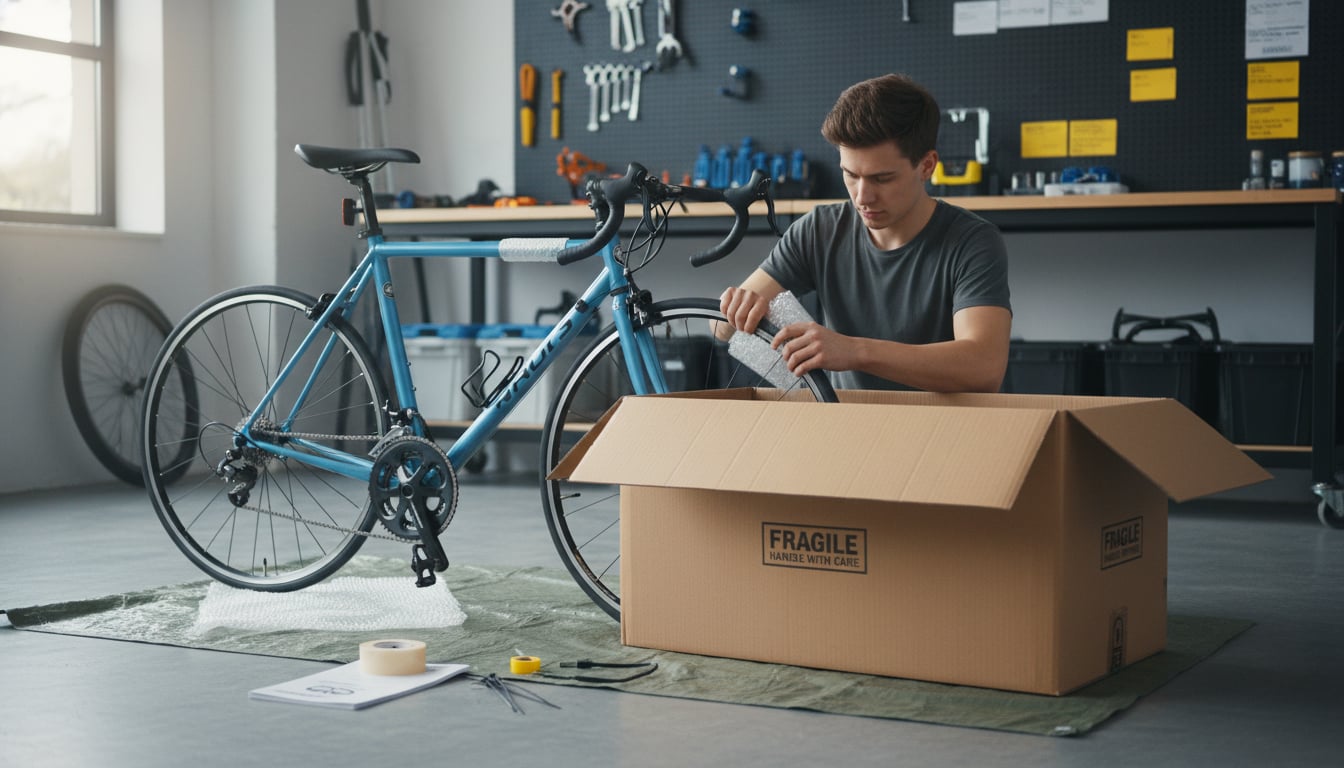
- DIY Packing: This is the most budget friendly option. You’ll need to get a cardboard bike box (you can often get one for free from a local bike shop) and some packing materials like bubble wrap and tape. It takes time and a bit of mechanical know how, but you’ll save on labor costs.
- Bike Shop Packing: If you’re not comfortable taking your bike apart or just want to save time, paying for a professional packing service is a great choice. A bike shop will typically charge between $50 and $100 to properly disassemble and secure your bike in a box. This fee gives you peace of mind knowing it was packed by an expert, which can also be helpful if you need to file an insurance claim later.
Why Bike Disassembly is Non Negotiable
You can’t just roll a bike into a box. To ship it affordably, you must perform some basic bike disassembly. This process makes the bike smaller, which is crucial for avoiding expensive oversize fees. Typically, you will need to:
- Remove the front wheel.
- Take off the pedals.
- Remove or turn the handlebars sideways.
- Lower or remove the seat and seat post.
By doing this, you can fit the bike into a much more compact box. Since carriers often use dimensional weight to price large packages, a smaller box directly translates to a lower shipping cost.
All About the Box: Size and Weight Limits
The box itself is a key part of the equation. You’ll need to pay close attention to its dimensions and the final packed weight.
Finding a Cardboard Bike Box
A proper cardboard bike box is made of sturdy, double walled corrugated cardboard. Typical dimensions are around 54 inches long, 8 inches wide, and 28 inches high. This size is designed to fit a standard bike while staying just under most carriers’ oversize limits. You can often get these from bike shops or buy them from shipping supply stores.
Understanding Box Dimension Limits
Carriers have strict rules about package size. The most common limit is a combined 130 inches in length plus girth. Girth is calculated as (2 x Width) + (2 x Height).
A standard bike box measuring 48 inches long, 8 inches wide, and 30 inches high has a length plus girth of 124 inches (48 + 2*(8+30)), which is safely under the 130 inch limit. Going over this limit can result in hefty surcharges.
The Magic Number: Staying Under 50 Pounds
The 50 pound weight threshold is critical. For both airlines and shipping carriers, 50 pounds is the line between a standard package and an “overweight” or “heavy” one.
- Airlines: A bike box under 50 pounds often flies for the standard checked bag fee. A box that is 51 pounds could trigger an overweight baggage fee of $75 to $150.
- Carriers: UPS and FedEx apply an “Additional Handling” surcharge for packages weighing more than 50 pounds. This can add around $25 to $30 to your bill.
Keeping your packed bike under this threshold is one of the easiest ways to ensure you’ve found the cheapest way to ship a bike.
Decoding the Factors That Determine Your Shipping Cost
Several variables influence the final price tag on your shipment. Understanding them will help you avoid surprises.
Dimensional Weight Explained
Have you ever shipped a big, light box and been shocked by the price? That’s likely because of dimensional weight (or DIM weight). Carriers use this pricing model for large items, charging you for the space the box takes up, not just its actual weight.
The formula is generally (Length x Width x Height) / Divisor. For UPS and FedEx, the divisor is often 139. If you need a refresher, see our step by step guide on how to calculate shipping costs.
Shipping Distance and Zones
It’s simple: the farther your bike has to travel, the more it will cost. Carriers divide the country into shipping zones based on the distance from your origin zip code. A short trip to a neighboring state might be Zone 2, while a coast to coast shipment is Zone 8. Each increase in zone number comes with a higher price.
Ground Shipping vs. Expedited Shipping
- Ground Shipping: This is your go to for saving money. Your package travels by truck, and delivery usually takes between two to five business days domestically. It’s reliable and by far the most economical choice.
- Expedited Shipping: If you need your bike to arrive in a day or two, you’ll have to pay a premium for air transport. But be prepared for sticker shock. Overnighting a bike across the country can cost $750 or more. Unless speed is absolutely critical, ground shipping is the cheapest way to ship a bike.
Not sure which service is the best fit for your budget and timeline? You can quickly use an online shipping calculator to compare the costs and delivery estimates for both ground and expedited options side by side.
Leveraging Business or Club Discounts
If you are part of a cycling club or own a business, you may have access to special shipping rates. Some cycling organizations and clubs partner with shipping services to offer members discounted rates. Similarly, business accounts with carriers like FedEx or UPS can unlock significant savings, especially for oversized packages or frequent shipments.
Special Considerations: E bikes, International, and Peak Season
Some situations come with extra costs you’ll need to factor in.
- E bike Battery Hazmat Fee: Shipping an e bike? Its large lithium ion battery is considered hazardous material. Carriers will ship them via ground but will add a hazmat fee of around $30 to $50 to cover special handling.
- International Shipping Customs and Duty: Sending a bike abroad is more complex. On top of higher shipping costs (often $200 or more), the recipient will likely have to pay import duties and taxes levied by their country’s customs agency. For a deeper walkthrough of services, forms, and savings strategies, see our guide to the cheapest international shipping.
- Peak Season Surcharges: During the busy holiday season (usually October through January), carriers add temporary surcharges to manage the surge in volume. This can increase your shipping cost by a few dollars or more, especially for large packages.
Declared Value vs. Shipping Insurance
It’s crucial to understand that declared value is not the same as shipping insurance.
- Declared Value: This is the carrier’s maximum liability for your package. Most carriers automatically include $100 of liability. If you declare a higher value, you pay an extra fee, but to receive a payout for a lost or damaged item, you often must prove the carrier was at fault.
- Shipping Insurance: This is a separate policy that protects your bike against loss or damage, often without needing to prove carrier negligence. For a valuable bike, purchasing true shipping insurance to cover its full value is a wise investment. It usually costs about $1 to $2 for every $100 of coverage and provides much better protection.
The USPS Option: Using Ground Advantage
The United States Postal Service can be a competitive option, especially with its USPS Ground Advantage service, which replaced Retail Ground and Parcel Select Ground. For current service details, size limits, and rate examples, see our USPS shipping guide.
The USPS Ground Advantage size limit is 130 inches in combined length and girth, and the weight limit is 70 pounds. This is large enough to accommodate most standard bike boxes. However, be aware that packages measuring between 108 and 130 inches will incur an oversized price. To skip the Post Office line, you can schedule a USPS pickup for your boxed bike.
Your Action Plan for the Cheapest Way to Ship a Bike
- Disassemble and Pack Smart: Take the time to break down your bike to fit into the smallest, most secure box possible. Aim to keep the total weight under 50 pounds.
- Compare, Compare, Compare: This is the most important step. Don’t just guess which service is cheapest. Use a free multi carrier shipping calculator to instantly see rates from bike shipping services, USPS, UPS, and FedEx.
- Buy Labels Online: Never pay full retail at the counter. Always purchase your label online to access commercial pricing and direct carrier discounts, our shipping label guide explains options and best practices.
- Choose Ground Shipping: Unless you’re in a huge hurry, stick with ground service to save a significant amount of money.
- Insure Your Ride: For a few extra dollars, add enough shipping insurance to cover the full value of your bike for total peace of mind.
By following these steps, you can be confident that you’ve found the absolute cheapest way to ship a bike for your specific needs.
Frequently Asked Questions
What is the absolute cheapest way to ship a bike?
Often, the cheapest way to ship a bike domestically is by using a specialized bike shipping service like BikeFlights. They offer discounted ground shipping rates that are typically lower than paying retail prices directly with UPS or FedEx.
Is it cheaper to fly with a bike or ship it?
It depends on the airline. If you can keep your packed bike under 50 pounds and within standard dimension limits, flying with it on an airline like American or Alaska can be cheaper (just the standard $35 bag fee) than shipping it. However, if you exceed those limits, shipping is almost always the cheaper option.
How much does it cost to ship a bike with USPS?
Shipping a bike with USPS Ground Advantage can cost anywhere from $100 to $250, depending on the distance (zone) and the final dimensions of your box. Remember that you will likely pay an extra oversized fee because the box will be between 108 and 130 inches in combined length and girth.
Can I ship a bike without taking it apart?
No, you must partially disassemble a bike to ship it affordably. A fully assembled bike is far too large and would have to be sent via LTL freight, which is much more expensive for a single bike.
What’s the best way to get a bike box for shipping?
The best way is to ask your local bike shop. They receive new bikes in sturdy cardboard boxes all the time and are often happy to give away their extras for free or for a small fee.
Do I need to buy insurance when shipping my bike?
It is highly recommended. While carriers include a default liability of $100, this is not enough to cover most bikes. Purchasing additional insurance to cover the bike’s full replacement value protects you if it gets lost, stolen, or damaged in transit.
How much does it cost to have a bike shop pack my bike?
Most bike shops charge between $50 and $100 for a professional packing service. This fee usually includes the box, packing materials, and the labor to properly disassemble and secure your bike for shipping.
What is dimensional weight and why does it matter for bikes?
Dimensional weight is a pricing method carriers use for large, lightweight packages. They charge based on the box’s volume, not its actual weight. This matters immensely for bikes because a bike box is very large for its weight, so you are almost always paying for its size, making a compact packing job essential.