
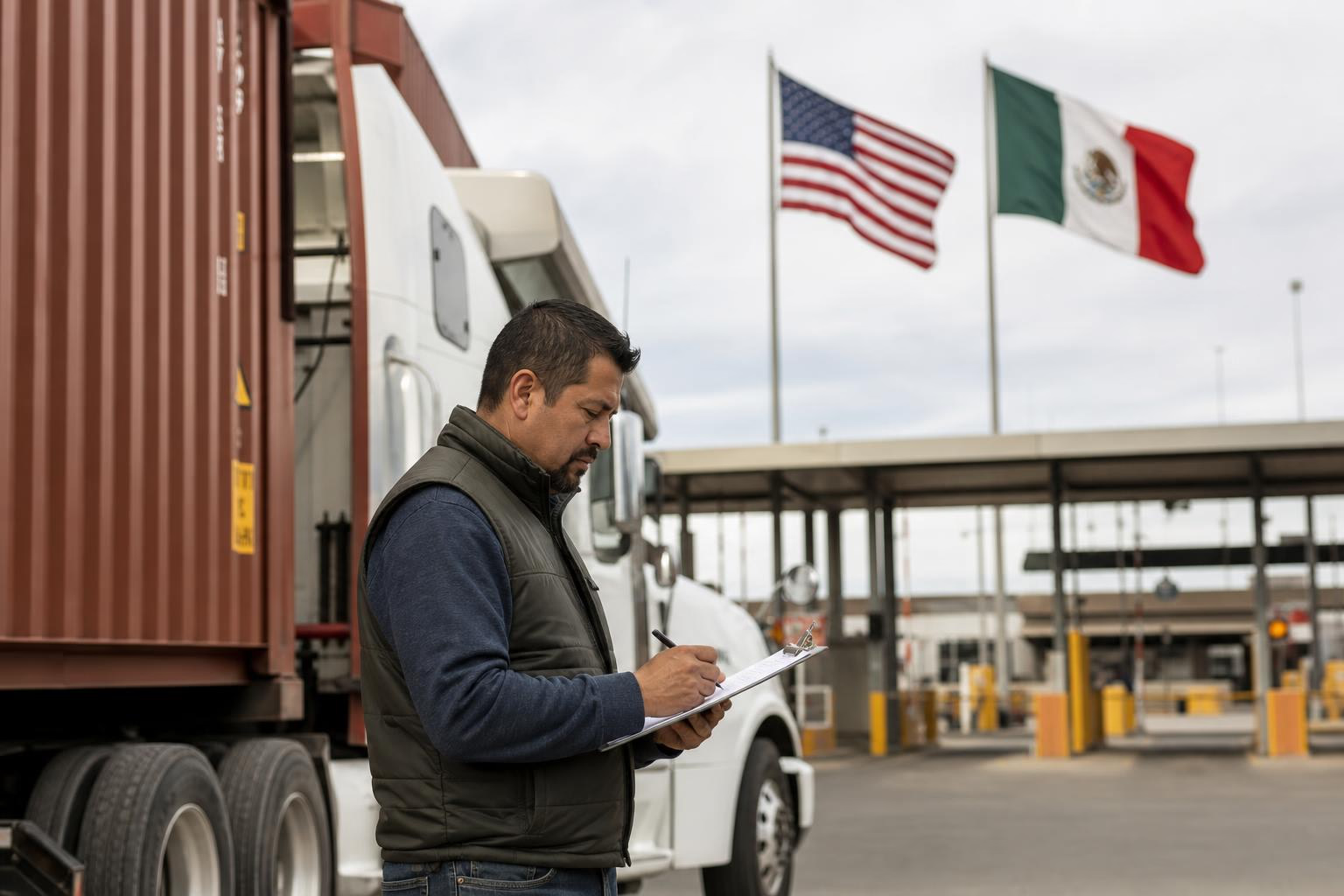
Ship to Mexico From US in 2026: Costs, Customs, Carriers
TL;DR
Shipping to Mexico from the US costs anywhere from $23 to $63+ depending on the carrier, service speed, and package weight. Mexico’s customs system has strict de minimis thresholds ($50 duty-free, $117 duty-free under USMCA), and as of 2025, every import declaration requires the recipient’s RFC tax ID. USPS is the cheapest option for lightweight packages, while FedEx and UPS offer faster, more reliable delivery because they handle customs brokerage themselves. Buying labels online instead of at a retail counter can save 40% or more.
Why Shipping from the US to Mexico Is Different
Sending a package across the US-Mexico border isn’t like shipping domestically with a different ZIP code. It involves customs declarations, potential import duties, specific address formatting, and a list of prohibited items that catches many first-time shippers off guard.
The US-Mexico-Canada Agreement (USMCA, formerly NAFTA) gives goods originating in the US preferential treatment at the Mexican border, but that doesn’t mean your package sails through without paperwork. Mexico updated its customs laws significantly in 2025 and 2026, tightening requirements around tax IDs, digital invoices, and shipment splitting. Understanding these rules before you print a label saves real headaches.
Whether you’re an e-commerce seller expanding south, an expat sending care packages, or someone shipping a birthday gift to family in Guadalajara, this guide covers every step of the process.
Compare rates for your Mexico shipment using our free calculator before choosing a carrier.
Carrier Options for Shipping to Mexico from the US
The four major carriers all serve the US-to-Mexico corridor, but their services, speeds, and pricing differ significantly. Here’s what each offers in 2026.
USPS
USPS provides four international services to Mexico:
- Priority Mail Express International (PMEI): 3 to 5 business days. Flat Rate Envelope starts at $62.70 retail in 2026. Best for urgent, lightweight documents or small items.
- Priority Mail International (PMI): 6 to 10 business days (officially). Flat Rate starts at $32.65. The most popular choice for medium-weight packages.
- First-Class Package International Service: For items under 4 lbs. The cheapest USPS option for small, light shipments.
- First-Class Mail International: Letters and large envelopes only.
There’s an important caveat with USPS that most guides gloss over. Once your package reaches Mexico, USPS hands it off to Correos de México (the Mexican postal system). Practitioners on Reddit’s r/mexicoexpats consistently report that this handoff adds days or even weeks to delivery times. The “6 to 10 business days” estimate from USPS reflects their portion of the journey, not the full door-to-door experience. For a deeper look at USPS pricing tiers, check our USPS rates and services guide.
UPS
- UPS Worldwide Express: 1 to 3 business days. Premium pricing, but UPS handles customs clearance directly.
- UPS Worldwide Saver: Slightly longer transit, slightly lower cost than Express.
- UPS Standard (Ground): A ground-only option specifically available for Canada and Mexico. Useful for heavier, less time-sensitive shipments where you want to avoid air freight pricing.
One thing to watch: UPS added a temporary per-pound surcharge on US exports effective April 19, 2026, at $0.23 per pound for most countries including Mexico. It has no announced end date, so factor it into your cost calculations.
FedEx
- FedEx International Connect Plus: Currently one of the best value options for shipping to Mexico from the US, with estimated costs around $23 for a 5 lb package from New York and delivery in 2 to 5 days.
- FedEx International Priority: 1 to 3 business days. The go-to for time-sensitive shipments.
- FedEx International Economy: Slower but cheaper than Priority.
DHL Express
DHL Express Worldwide is the fastest option for sending packages to Mexico as of 2026, but speed comes at a price. FedEx and UPS economy options run 30 to 40% cheaper than DHL Express, though with longer transit times. DHL is rarely mentioned by casual shippers in community forums. It’s primarily a choice for businesses shipping volume.
Which Carrier Is “Cheapest”?
There’s no single answer. The cheapest option depends on your package’s weight, dimensions, origin city, and how fast it needs to arrive. A 1 lb envelope from Houston has completely different economics than a 15 lb box from Seattle. To understand the factors driving these differences, read about how shipping costs are calculated.
2026 Rate Increases
All major carriers raised prices this year. FedEx, UPS, and DHL each implemented a 5.9% general rate increase for 2026, while USPS implemented service-specific international price changes effective January 18, 2026. The headline 5.9% number understates reality. When surcharges are factored in, most shippers see an effective increase between 8% and 12%. For more on how surcharges work, see our guide on carrier fuel and handling surcharges.
Retail vs. Discounted Online Rates: The Biggest Savings Opportunity
This is the single most overlooked factor when people ship to Mexico from the US. Walking into a Post Office, UPS Store, or FedEx Office and paying the counter price means paying full retail. Buying the same label online through shipping software can cut costs by 40% or more.
Here’s why: carriers offer “commercial” or “online” pricing to incentivize digital label creation, which reduces their labor costs. When you use tools like USPS Click-N-Ship or multi-carrier shipping software, you access these lower rates automatically.
The savings are substantial enough that even occasional shippers should print labels at home. For frequent shippers or small businesses, the difference between retail and commercial pricing can amount to hundreds of dollars per month.
See how shipping discounts work and how to access commercial rates without a carrier contract.
Mexico’s Import Duties and De Minimis Thresholds (2026)
This is the area where most shipping guides fail. They’ll say “duties may apply” and leave it at that. Here are the actual numbers your recipient needs to know.
USMCA-Origin Goods (Shipped from the US by Courier)
- $0 to $50 USD declared value: Exempt from both customs duties and taxes. Completely free to import.
- $50.01 to $117 USD: Exempt from customs duties under USMCA, but subject to Mexico’s standard 16% IVA (Impuesto al Valor Agregado, Mexico’s value-added tax).
- Over $117 USD: Subject to both customs duties and 16% IVA.
Worked Example
You ship a $100 gift to your cousin in Mexico City. Under USMCA rules, it falls in the $50 to $117 bracket. No customs duty applies, but your cousin will owe 16% IVA on the declared value: $16. That’s paid at delivery or during customs clearance.
Now imagine you ship something worth $200. That exceeds the $117 threshold, so your cousin pays both customs duties (rates vary by product category, but a simplified 19% global rate applies to courier imports) and 16% IVA. The total tax bill: roughly $70 on top of what you already paid for shipping.
Non-USMCA Goods Get Hit Harder
If items don’t qualify as USMCA-origin (for example, goods manufactured in China that you’re forwarding from the US), Mexico applies a 33.5% global rate on simplified courier imports as of August 15, 2025.
Critical: Duties Are NOT Included in Your Shipping Label
The cost you pay for postage covers transportation only. Import duties and IVA are the recipient’s responsibility unless you specifically arrange Delivered Duty Paid (DDP) shipping through your carrier. To understand the difference, our guide on DDP vs. DDU shipping breaks it down clearly.
New Mexico Customs Rules You Need to Know
Mexico’s customs environment changed substantially in 2025 and 2026. These rules affect everyone who ships to Mexico from the US, not just businesses.
RFC Requirement (Effective January 1, 2025)
As of January 1, 2025, all import declarations, regardless of value or transport mode, must include the recipient’s RFC (Registro Federal de Contribuyentes), which is Mexico’s taxpayer identification number. If the RFC is missing, the shipment cannot use the simplified customs lane and must go through standard procedures, adding delays and potential extra costs.
This means you should collect your recipient’s RFC before shipping. Ask them for it the same way you’d ask for their phone number. Without it, your package may sit in customs limbo.
Digital Invoice Required
Mexico’s 2026 Customs Law requires a digital invoice for every shipment, even if the declared value is zero. No invoice means seizure. This doesn’t have to be a formal commercial invoice for gift shipments, but you need a document listing the items, their values, and the sender/recipient details.
Shipment Splitting Is Now Illegal
Sending one order as multiple small packages to stay under the de minimis threshold is explicitly prohibited under the 2026 rules. If Mexican customs detects this, all packages are aggregated and you pay duties on the total value plus a 30% penalty. This practice was common enough that legislators specifically targeted it.
Two-Tier Formal Entry System
Anything declared above $250 USD must now go through a formal customs entry with a licensed customs broker in Mexico. This adds cost and complexity for higher-value shipments.
Customs Forms and Documentation
When you ship items from the US to another country, you must fill out customs forms (the exception is First-Class Mail International letters and large envelopes under 15.994 oz).
What You Need to Provide
- Detailed item descriptions: “Clothes” won’t cut it. Write “women’s cotton t-shirt, new, size medium.” Vague descriptions lead to rejection, return, or destruction of your package.
- HS codes: These are standardized product classification numbers. You don’t need to look them up yourself. If you use USPS tools like Click-N-Ship and provide accurate item descriptions, USPS assigns the correct HS codes automatically. For a deeper explanation, see our customs form guide.
- Declared value: Be accurate. Undervaluing items to dodge duties is customs fraud in both countries.
- Recipient’s RFC: As discussed above, mandatory since January 2025.
- Recipient’s phone number and email: Not technically required on every form, but including them speeds up clearance significantly. Mexican customs agents use this contact info to resolve issues without sending your package back.
USPS Click-N-Ship is the most efficient method for most people. It lets you enter all required information, generates compliant customs forms, charges discounted Commercial Rate postage, and prints complete shipping labels from home.
How to Format a Mexican Shipping Address
Mexico’s address system confuses international shippers because it includes colonias (neighborhoods) and a specific ordering that differs from US conventions. Getting this wrong causes real problems. Omitting the colonia increases delivery failures by up to 40%, according to postal data analysis, because many Mexican cities have duplicate street names across different colonias.
Correct Format
MARIA FERNANDA RODRIGUEZ
AVENIDA REFORMA 222 PISO 10
COLONIA JUAREZ
06600 CIUDAD DE MEXICO, CMX
MEXICO
Field-by-Field Breakdown
- Recipient name (full name, no abbreviations)
- Street address including number, floor, apartment, or suite
- Colonia (neighborhood), preceded by “COLONIA” or “COL.”
- Postal code + City + State abbreviation
- MEXICO in capital letters on its own line
Common Mistakes
- Leaving out the colonia entirely
- Putting the postal code after the state instead of before the city
- Forgetting to write “MEXICO” as the country on the last line
- Using a US-style format with the state after the ZIP code
For general package addressing tips, our guide on how to address a package covers the fundamentals.
Prohibited and Restricted Items When You Ship to Mexico from the US
Mexico prohibits some items you might not expect. Getting this wrong means your package gets seized with no refund on postage.
Prohibited (Cannot Ship Under Any Circumstances)
- Narcotics and controlled substances
- Firearms and ammunition
- Electronic cigarettes, vaping devices, and their components
- Used clothing for commercial purposes (outside personal luggage)
- Used tires
- Predatory live fish
- Images depicting children in a degrading manner
The Used Clothing Trap
This deserves special attention because it’s the exact scenario discussed in the Reddit thread that ranks #3 for this search term. Users on r/mexicoexpats frequently ask about shipping large boxes of clothes and shoes to Mexico. Here’s the rule: shipping used clothes or shoes for resale or as a gift is strictly prohibited unless the items are part of your personal luggage during travel. Even if you’re sending your own clothes to yourself after relocating, multiple units of the same item can trigger commercial-import suspicion at customs.
New items in sealed retail packaging are generally fine, but large quantities of even new clothing can raise flags.
Restricted (Special Rules Apply)
- Electronics: NOM (Norma Oficial Mexicana) certifications are strictly enforced in 2026 for electronics and professional equipment. Sending a personal laptop is usually fine, but shipping multiple units of the same electronic device will likely require certification.
- Toys: Subject to import restrictions and safety standards.
- Wool and leather products: Various restrictions apply.
- Goods from China: Additional scrutiny and restrictions on certain Chinese-origin products, especially clothing.
Tips from Real Shippers
Community discussions across Reddit, Quora, and expat forums reveal patterns that official carrier pages don’t mention.
USPS is cheapest but unreliable on timing. The consistent feedback from practitioners is that USPS international services work fine for the US leg of the journey, but once Correos de México takes over, tracking goes dark and delivery windows stretch. If your package isn’t time-sensitive and is worth less than $200, USPS is the pragmatic choice.
FedEx and UPS are worth the premium for valuable items. Express couriers handle their own customs brokerage in Mexico, meaning your package doesn’t enter the general Mexican postal system. Users on Quora emphasize that the “safety” concern with Mexico shipping isn’t about theft in transit. It’s about packages getting lost or stuck indefinitely in Mexican customs. Paying more for FedEx or UPS buys you a smoother customs process.
Always insure valuable packages. USPS coverage is limited to $200 for merchandise shipped via Priority Mail International. If you’re shipping something worth more, either upgrade to PMEI (which includes higher coverage) or purchase additional insurance.
Plan around de minimis thresholds. If you’re shipping gifts, keeping the declared value at or below $50 means your recipient pays nothing at the door. Going even slightly over that threshold triggers 16% IVA, which can be an unwelcome surprise.
Include the recipient’s phone number and email on every customs form. This is the single most practical tip for avoiding delays. When customs agents have questions, they contact the recipient directly instead of bouncing the package back.
Buy labels online, not at the counter. This applies to all shipping, but especially international. The savings on a single Priority Mail International package can be $10 or more compared to the retail counter price. Over multiple shipments, it adds up fast.
Compare discounted carrier rates for your specific package dimensions and destination city in Mexico.
Frequently Asked Questions
What is the cheapest way to ship to Mexico from the US?
For packages under 4 lbs, USPS First-Class Package International Service is typically cheapest. For heavier packages, FedEx International Connect Plus often beats other options (around $23 for a 5 lb package from the East Coast). The only way to know for sure is to compare rates based on your specific package weight, dimensions, and origin city, because pricing varies significantly by these factors.
Will my recipient have to pay taxes or duties on a package from the US?
If the declared value is $50 or less and the goods originate in the US (qualifying under USMCA), no duties or taxes apply. Between $50 and $117, no duty applies but 16% IVA (Mexico’s value-added tax) is charged. Above $117, both duties and IVA apply. These thresholds are for courier-shipped goods. Postal shipments may have slightly different treatment.
What is an RFC and why does my recipient need one?
RFC stands for Registro Federal de Contribuyentes, Mexico’s taxpayer identification number. Since January 1, 2025, all import declarations must include the recipient’s RFC. Without it, packages get routed through slower, more complex standard customs procedures instead of the simplified lane. Ask your recipient for their RFC before you ship.
Can I ship used clothes to Mexico?
Not for commercial purposes, and the definition of “commercial” is broad. Shipping large quantities of used clothing or shoes, even as gifts, is prohibited and will result in seizure. Single items of personal clothing being sent to yourself or a family member may pass, but multiple units of the same item will raise red flags. New items in original retail packaging are generally acceptable.
How long does shipping to Mexico actually take?
Official carrier estimates: USPS Priority Mail International says 6 to 10 business days, FedEx International Connect Plus says 2 to 5 days, and UPS Worldwide Express says 1 to 3 days. Real-world experience: FedEx and UPS tend to hit their windows because they control the full delivery chain in Mexico. USPS shipments frequently take 2 to 4 weeks total once Correos de México handles the final mile.
Do I need to fill out customs forms for every package?
Yes, with one narrow exception: First-Class Mail International letters and large envelopes under 15.994 oz don’t require customs forms. Every other package shipped from the US to Mexico needs a completed customs declaration with detailed item descriptions, declared values, and the recipient’s RFC.
Can I ship electronics to Mexico?
Yes, but Mexico’s NOM certification requirements are strictly enforced in 2026. Personal electronics (one laptop, one phone) generally clear customs without issues. Shipping multiple units of the same electronic product triggers commercial import requirements, including NOM certification, which is expensive and complex. If you’re a business shipping electronics, work with a customs broker.
Is it better to use USPS Flat Rate boxes or regular packaging for Mexico shipments?
It depends on weight. USPS Flat Rate boxes charge one price regardless of weight (up to 70 lbs), making them excellent for heavy, compact items. But for lighter shipments, regular packaging with weight-based pricing is often cheaper. Our guide on flat rate vs. regular shipping walks through the math for different scenarios.