
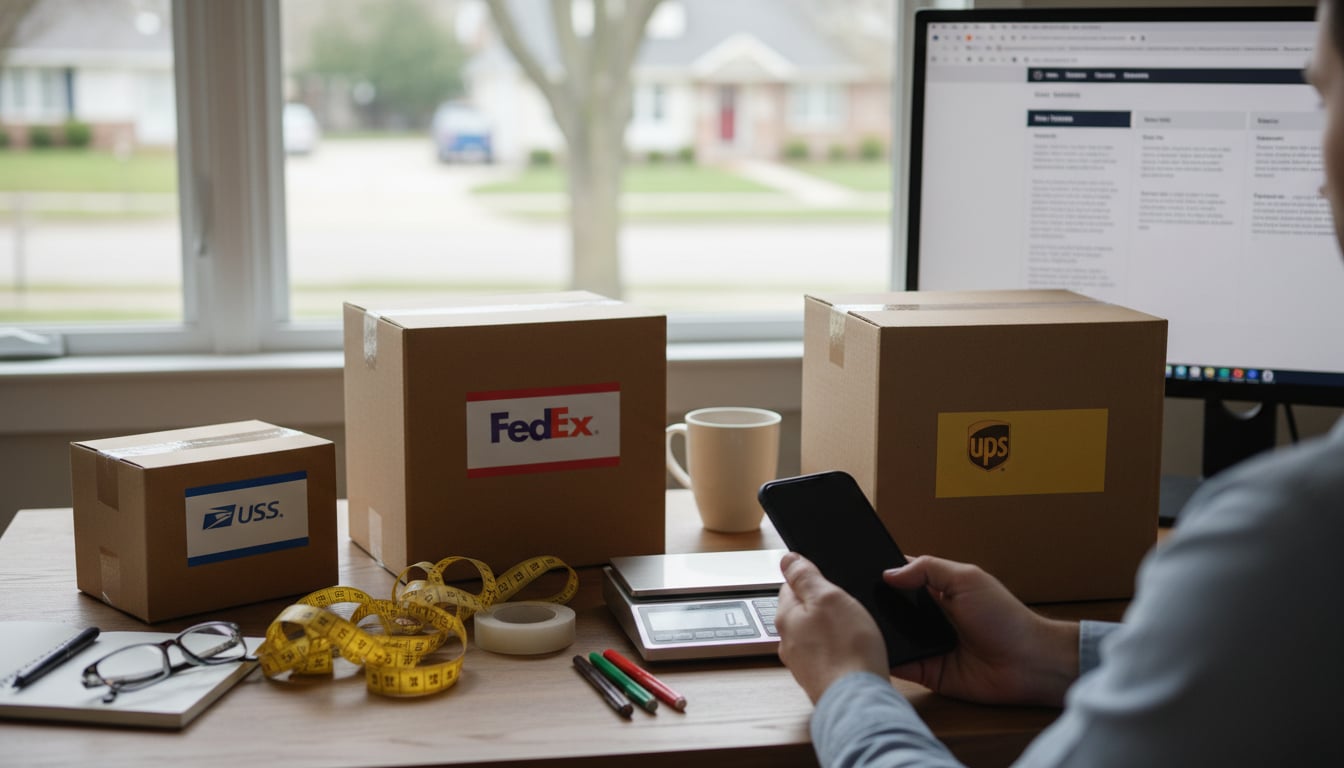
Compare Shipping Rates USPS, UPS and FedEx (2026 Guide)
Figuring out the cheapest way to ship a package can feel like solving a puzzle. With so many carriers, service levels, and surprise fees, it’s easy to wonder if you’re overpaying. Generally, USPS offers the best rates for lightweight packages, while UPS and FedEx are more competitive for heavy items, but the cheapest option always depends on your shipment’s specific details. The good news is that once you understand the key factors that drive costs, you can confidently choose the best option every time.
This guide breaks down everything you need to know to properly compare shipping rates USPS UPS and FedEx. We’ll explore how weight, speed, surcharges, and other hidden details affect your total cost, so you can save money on your next shipment.
The Biggest Factor: How Package Weight Affects Shipping Rates
The single most important factor in your shipping cost is the weight of your package. Each carrier has sweet spots where they offer the best pricing.
Small Packages (Under 1 lb)
For lightweight shipments, USPS is almost always the king. If you’re sending something that weighs less than 16 ounces, the Postal Service offers dedicated services that private carriers can’t match on price.
USPS Ground Advantage (which replaced First Class Package Service) is designed specifically for these items. See our USPS shipping guide: rates, calculator, and chart for current details. It’s perfect for small ecommerce products like tshirts or books, often costing just a few dollars for delivery within 1 to 3 days. UPS and FedEx typically round up to a 1 pound billing weight, making their services for a 12 ounce package significantly more expensive than USPS.
Medium Packages (1 to 10 lbs)
This is where things get competitive. In the 1 to 10 pound range, the price differences between USPS, UPS, and FedEx begin to shrink. For a 5 pound package, the base rate for ground service from any of the major carriers might fall within a similar $10 to $15 range.
In this weight class, the shipping distance (or zone) becomes a huge factor. USPS might be cheaper for a shorter trip, while UPS or FedEx Ground could offer a better rate for a cross country shipment. One study found that for a 10 pound package, FedEx Ground was the cheapest option by about $5. Because no single carrier is always the cheapest here, it’s critical to compare shipping rates USPS UPS and FedEx for every medium‑weight shipment. Start with our analysis of which is cheaper: UPS or USPS.
Heavy Packages (Over 10 lbs)
Once your package gets heavy, your best options are almost always UPS and FedEx. USPS has a strict weight limit of 70 pounds for all its services and its rates for packages over 20 pounds are often much higher than private carriers. UPS and FedEx can handle packages up to 150 pounds, making their ground networks the go‑to choice for bulky items. See our comparison of FedEx vs. UPS for heavy shipments.
For these shipments, always select a ground service. Trying to send a 50 pound box via 2 Day Air will result in a shocking bill. Between the two, analysis has sometimes shown FedEx Ground or FedEx Home Delivery to be slightly cheaper for very heavy parcels.
Speed vs. Cost: Choosing the Right Delivery Service
After weight, the next biggest decision is how fast you need your package to arrive. This choice creates a classic tradeoff between speed and your budget.
Ground Shipping: The Budget Friendly Choice
Ground shipping is the most economical way to send a package that isn’t urgent. Services like UPS Ground, FedEx Ground, and USPS Ground Advantage use trucks and rail to transport packages, which is much cheaper than air travel. A typical ground delivery takes 1 to 5 business days.
Choosing ground over an express service can save you a fortune. For example, a 10 pound package might cost around $20 to $26 to ship via ground, while sending it overnight could easily exceed $100. For an even starker comparison, one analysis showed a 10 pound box costing about $19.95 with USPS Ground Advantage versus $113.95 with USPS Priority Mail Express.
Expedited and Overnight: When Speed Is a Must
When you need a package to arrive quickly, you’ll want to look at expedited (2 or 3 day) and overnight (next day) services. FedEx and UPS are renowned for their fast, reliable air networks, offering services like FedEx 2Day, UPS 2nd Day Air, and UPS Next Day Air.
This speed comes at a premium. An overnight shipment can cost 5 to 6 times more than a ground shipment. That same 10 pound package that was about $25 via ground could cost an average of $148 for overnight delivery. USPS offers a more affordable option with Priority Mail Express, but it often has fewer time specific delivery guarantees than UPS or FedEx.
The Tradeoff: Making the Smart Choice
Ultimately, you have to decide if the faster delivery is worth the extra money. For a last minute gift or a critical document, paying for overnight shipping might be necessary. But for most routine shipments, the cost savings of ground service are hard to ignore. Many customers will choose slower free shipping over paying a premium for speed. A great way to visualize this is to use an online shipping calculator to see the prices for different service speeds side by side.
Hidden Costs: Surcharges That Inflate Your Bill
The rate you’re first quoted isn’t always what you’ll pay. Carriers add various surcharges that can significantly increase your final cost. A comprehensive effort to compare shipping rates USPS UPS and FedEx must account for these fees.
Residential Surcharge
UPS and FedEx add a fee for delivering to a home address, as it’s less efficient than delivering multiple packages to a single business. This residential surcharge is a flat fee per package, typically around $5.70 for UPS Ground. USPS does not charge a residential surcharge, which is a major reason it can be cheaper for home deliveries.
Extended Area Fee
If you’re shipping to a rural or remote location, UPS and FedEx will add an extended area surcharge. This fee covers the extra cost of driving to a location far from their distribution hubs. This can add another $7 or more on top of the base rate and the residential surcharge. Again, USPS delivers to every U.S. address, including rural ones, without this extra fee.
Fuel Surcharge
All major carriers add a fuel surcharge to cover fluctuating energy prices. This is calculated as a percentage of your base shipping cost and can change weekly. In late 2025, the UPS domestic ground fuel surcharge hit 21.75%, adding a significant amount to every bill. This fee is unavoidable with private carriers and is automatically included in the final price.
It’s Not Just Weight: Other Key Pricing Factors
Beyond weight, speed, and surcharges, a few other structural elements of pricing can surprise you if you’re not aware of them.
Dimensional Weight Pricing
Carriers use dimensional (DIM) weight to charge for packages that are large but light. They calculate a billable weight based on the package’s volume using a formula: (L x W x H) / Divisor. You are charged for whichever is greater: the actual weight or the DIM weight.
UPS and FedEx use a DIM divisor of 139, while USPS uses a more generous 166. This means a big, light box will get a higher billable weight from UPS and FedEx. For example, a 16″ × 12″ × 10″ box weighing just 2 pounds would be billed as a 12 pound package by USPS, but a 14 pound package by UPS or FedEx. The key is to use the smallest box possible.
Flat Rate vs. Weight Based Rates
Flat rate shipping lets you pay one price for any weight (up to a limit) as long as it fits in the carrier’s special packaging. This can be a great deal for heavy items going a long distance. A USPS Medium Flat Rate Box costs $17.10 to ship anywhere in the U.S. (up to 70 lbs). If you were shipping a 15 pound item cross country, this would likely be much cheaper than a weight based rate.
However, for lighter items or short distances, standard weight based pricing is almost always cheaper. If your package weighs less than 2 pounds and isn’t traveling far, you’ll save money by avoiding the flat rate box.
Zone Based Pricing
Carriers use shipping zones to price packages based on distance. The U.S. is divided into zones 1 through 8, and the higher the zone number, the farther the distance and the higher the cost. Shipping a 5 pound package to a nearby Zone 2 might cost around $10.60, while sending that same package to a Zone 8 address cross country could easily cost twice as much. This is why a centrally located warehouse is a huge advantage for businesses.
Unlocking Savings and Navigating Carrier Rules
Now that you understand the costs, let’s talk about how to lower them and deal with carrier specific rules.
Accessing Discounted Rates
You should almost never pay the full retail price you see at a UPS Store or Post Office counter. By purchasing postage online through shipping software, you can access commercial rates that are significantly discounted. Here’s how to get shipping discounts without negotiating contracts. Platforms often provide access to programs like the UPS Digital Access Program, which can offer up to 50% off ground shipping rates. Similarly, USPS Commercial Pricing can save you up to 40% or more on services like Priority Mail.
Free vs. Paid Package Pickup
Getting your packages to the carrier is another consideration. USPS offers free package pickups from your home or office; you can schedule a USPS pickup online and your regular mail carrier will collect your shipments. This is a huge convenience for small sellers.
In contrast, UPS and FedEx typically charge a fee for on demand pickups, often around $4 to $7. To avoid this, you can drop your packages off at a carrier location like a UPS Store or FedEx Office for free.
P.O. Box and Coverage Constraints
A major difference between carriers is their delivery footprint. Only USPS can deliver packages to P.O. Boxes. Here’s what to know about getting a P.O. Box and when to use it. If your customer provides a P.O. Box address, you have no choice but to use a USPS service. Similarly, USPS is the only carrier that delivers to military APO/FPO addresses. This constraint can sometimes force you to use a more expensive service than you otherwise would have chosen.
Weekend Delivery Costs
Carrier weekend delivery policies can affect both cost and speed. USPS delivers on Saturdays at no extra charge; for Sunday specifics, see USPS Sunday delivery. FedEx Home Delivery also includes Saturday and Sunday delivery as part of its standard service. UPS Ground now includes Saturday delivery to many residential areas. However, for express services from UPS and FedEx, a Saturday delivery requires a special surcharge, which is often around $16 per package.
The Bottom Line: Best Carrier by Use Case
To successfully compare shipping rates USPS UPS and FedEx, it helps to know their strengths.
- Best for Lightweight Packages (under 5 lbs): USPS is the clear winner with its Ground Advantage service.
- Best for Heavy or Large Packages (over 10 lbs): UPS and FedEx are more cost effective and have higher weight limits (150 lbs vs. 70 lbs for USPS).
- Best for Fast and Urgent Delivery: FedEx and UPS have the most robust and reliable overnight and 2 day air networks.
- Best for E-commerce Residential Delivery: A mix is often best. Use USPS for light packages to avoid surcharges, and use FedEx Home Delivery or UPS Ground for heavier items to get weekend delivery.
- Best for P.O. Boxes or Rural Areas: USPS is your only option for P.O. Boxes and often the most reliable choice for very remote addresses.
The best strategy is to evaluate each shipment individually. Using a tool to compare shipping rates USPS UPS and FedEx on one screen is the most efficient way to ensure you’re always getting the best deal.
Frequently Asked Questions to Compare Shipping Rates USPS and FedEx
1. What is the absolute cheapest way to ship a small, light package?
For packages under one pound, USPS Ground Advantage is consistently the cheapest option available.
2. Who is generally cheaper for heavy packages, UPS or FedEx?
It’s very competitive, but some analyses show FedEx Ground often has a slight edge on price for very heavy parcels (50 lbs and up). However, it’s always best to compare them for your specific shipment, as rates can vary by destination.
3. How can I avoid residential and extended area surcharges?
The only way to completely avoid these surcharges is to ship with USPS, which does not apply these fees. If you must use UPS or FedEx, you cannot avoid them, but you should factor them into your total cost comparison.
4. Is it always cheaper to buy postage online?
Yes. Buying postage online through any authorized shipping software or platform gives you access to commercial rates, which are always cheaper than the retail rates you pay at a carrier’s physical store. The savings can be substantial, often between 15% and 50%.
5. When should I use a USPS Flat Rate box?
Use a USPS Flat Rate box when you are shipping a heavy item over a long distance. For example, a 20 pound item going from coast to coast will almost certainly be cheaper in a Large Flat Rate box than if you paid by weight and zone. For light items or short distances, weight based rates are cheaper.
6. How can I easily compare shipping rates from all carriers at once?
The easiest method is to use a free multi carrier tool. An aggregator site like Online Shipping Calculator allows you to enter your package details once and see the estimated commercial rates from USPS, UPS, and FedEx on a single page, saving you time and helping you find the lowest price.
Now that you’re armed with this knowledge, you can approach your shipping with confidence. By taking a moment to compare shipping rates USPS UPS and FedEx for each package, you can stop overpaying and start saving. Ready to see how much you can save? Instantly check your rates today!