
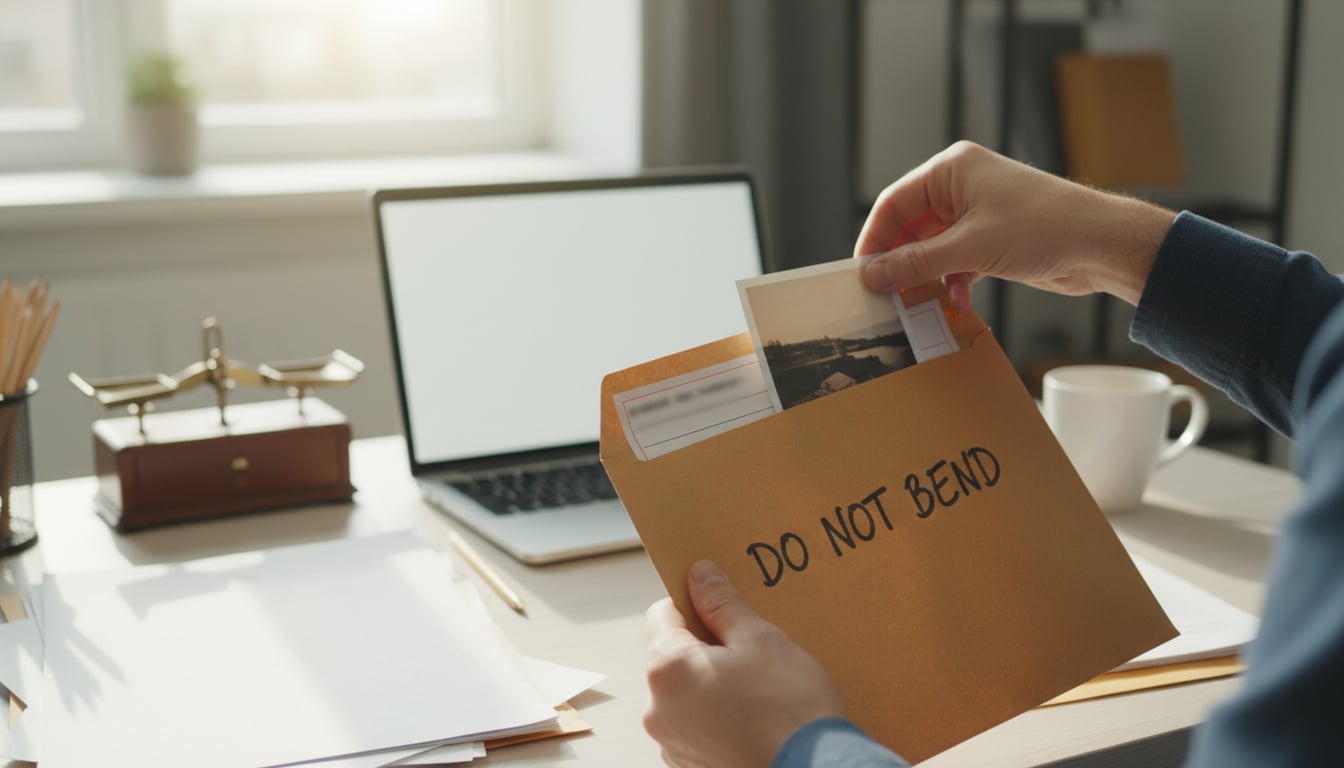
Can I Write 'Do Not Bend' on an Envelope? 2026 Rules
TL;DR
Yes, you can write “Do Not Bend” on an envelope. USPS does not prohibit the marking, and it won’t cost you extra postage by itself. However, USPS officially removed “Do Not Bend” from its Domestic Mail Manual in 2007, and roughly 95% of first-class mail is processed by automated sorting machines that completely ignore surface markings. The only reliable way to protect flat mail from bending is physical protection: cardboard stiffeners, rigid mailers, or shipping via Priority Mail.
What “Do Not Bend” on an Envelope Actually Means
“Do Not Bend” is a handling instruction written or stamped on an envelope asking anyone who touches it, from sorting facility workers to your mail carrier, not to fold or crease the contents. People typically write it when mailing photographs, certificates, diplomas, legal documents, art prints, or trading cards.
Before 2007, this marking carried real weight. The old USPS Domestic Mail Manual (DMM 601) explicitly stated that “markings such as ‘Do Not Bend’ must be used only when the content is protected with stiffeners.” In other words, USPS recognized the instruction but required you to back it up with actual physical protection.
That changed on August 16, 2007, when USPS published Postal Bulletin 22213, officially deleting the standards for the “Do Not Bend” marking. The current version of DMM 601 contains zero references to “Do Not Bend” or stiffeners. The term has been completely removed from USPS regulations.
So while nobody will stop you from writing “Do Not Bend” on an envelope, it is no longer an officially recognized USPS handling instruction.
Does USPS Honor “Do Not Bend” Markings?
No. Not in any systematic way.
The practical reality is that automated sorting equipment processes approximately 95% of first-class mail, running at speeds of up to 40,000 pieces per hour. These machines sort by barcodes and address data, not by reading handwritten notes on the envelope’s surface. Your carefully written “Do Not Bend” instruction passes through multiple high-speed sorting machines before a human ever sees it.
Practitioners on Reddit confirm this bluntly. A postal worker in r/usps_complaints stated: “Do not bend, fragile, or whatever sticker/writing saying those things mean nothing to the Post office. If you do not want something to be bent,” use protective packaging instead.
Postal carriers on the Rural Mail Talk forum share similar experiences. One carrier recalled that items labeled “Do Not Bend or Fold” were treated as flats and literally folded into sorting cases. When carriers confronted management about the absurdity of bending items marked “Do Not Bend,” management reversed course, but only after the damage was already done.
Multiple postal workers on Quora have confirmed that the only person who typically sees a “Do Not Bend” marking is the carrier putting mail in the mailbox at delivery. By that point, the envelope has already been through every sorting machine in the system.
The marking “Fragile” does still appear in the current DMM as an approved handling instruction, but only for packages, not for letters or flats. And even “Fragile” provides no guarantee of special handling during automated sorting.
If you’re new to mailing letters and want to understand the basics first, our guide on how to mail a letter walks through the entire process.
Does Writing “Do Not Bend” Cost Extra?
Writing it costs nothing. The marking itself carries no surcharge.
But here’s where things get tricky. If you write “Do Not Bend” on an envelope and actually protect the contents with a cardboard stiffener (which you should), that stiffener can make the envelope rigid. A rigid envelope triggers the USPS nonmachinable surcharge, currently $0.49 as of July 2025, on top of standard first-class letter postage of $0.78.
If the envelope becomes too rigid or exceeds the maximum dimensions for a flat (15" x 12" x 0.75" thick), USPS may reclassify it as a package, bumping the cost even higher.
This is the classification cascade that catches many people off guard:
| Scenario | Mail Class | Approximate Cost (2025) |
|---|---|---|
| Standard flexible letter (1 oz) | First-Class Letter | $0.78 |
| Letter with cardboard stiffener (rigid) | Nonmachinable Letter | $1.27 ($0.78 + $0.49 surcharge) |
| Large rigid envelope exceeding flat specs | Package rate | ~$4.50+ |
| Priority Mail Flat Rate Envelope | Priority Mail | $10.40 |
Under DMM 101, a letter is considered nonmachinable if it is too rigid to bend easily when subjected to belt tension of 40 pounds around an 11-inch diameter turn. Translation: if it doesn’t flex like a regular envelope, you’re paying more.
For a fuller picture of current stamp pricing, check our breakdown of how much a book of stamps costs.
What Actually Prevents Bending (Because the Label Won’t)
If writing “Do Not Bend” on an envelope doesn’t reliably protect your contents, what does? Physical protection. Here are the options ranked by cost and effectiveness.
Cardboard Stiffeners (DIY)
Cut two pieces of corrugated cardboard about a quarter inch larger than your document on all sides. Sandwich the document between them. Tape the edges to keep them from shifting. This costs under $0.25 in materials and provides solid protection against casual bending during sorting.
The catch: this makes your envelope rigid, which triggers the $0.49 nonmachinable surcharge on a standard letter. Your total postage for a 1-ounce letter becomes $1.27.
Rigid Cardboard Mailers (Stay-Flat Mailers)
Purpose-built rigid mailers with a 32 ECT (edge crush test) rating can withstand the forces of postal sorting machines. They cost between $0.50 and $1.50 each and are the standard choice for shipping photographs, prints, and documents.
Because they’re rigid, they will almost certainly be classified as nonmachinable letters or packages depending on size. Budget accordingly.
Priority Mail Flat Rate Envelope
This is the best option when your contents are genuinely valuable. For $10.40 (2025 retail price), you get a sturdy envelope with built-in cardboard backing, full tracking, delivery in 1 to 3 business days, and up to $100 of included insurance. That insurance is the key differentiator. Writing “Do Not Bend” gives you zero recourse if mail arrives damaged. Priority Mail gives you an actual claim process.
Wondering whether flat rate shipping makes sense for your situation? Our comparison of flat rate vs. regular shipping breaks down when each option saves money.
USPS Ground Advantage
For items that ship as packages (because they’re too rigid or large for letter/flat classification), USPS Ground Advantage starts around $4.50. Items classified as packages receive somewhat more careful handling than letters and flats at certain sorting stages, though they still pass through automated systems.
Quick Comparison
| Protection Method | Cost | Tracking | Insurance | Best For |
|---|---|---|---|---|
| DIY cardboard stiffeners | ~$1.27 total (postage + surcharge) | No | No | Low-value documents, casual mailing |
| Rigid stay-flat mailer | ~$1.50-$5.00 (mailer + postage) | No (letter) / Yes (package) | No | Photos, prints, certificates |
| Priority Mail Flat Rate Envelope | $10.40 | Yes | $100 included | Valuable documents, irreplaceable items |
| USPS Ground Advantage | ~$4.50+ | Yes | Available as add-on | Larger rigid items |
Where to Place a “Do Not Bend” Label on an Envelope
If you still want to write “Do Not Bend” on your envelope (and there’s no harm in doing so as an extra layer of awareness for your carrier), placement matters. Put it where a human can actually see it without the marking interfering with USPS processing.
Write or stick the label in the lower-left corner of the envelope’s front, at least 1 inch from the bottom edge and half an inch from the left edge. Keep it away from the address block, the barcode clear zone along the bottom, and the postage area in the upper right.
Write the same instruction on the back of the envelope too. The carrier who pulls it from their bag and slots it into your mailbox sees the back more often than the front.
For the best visibility, use bright red ink or fluorescent stickers, minimum 1 inch by 3 inches. Block letters work better than cursive.
If you want to make sure the rest of your envelope is properly formatted, our guide on how to address an envelope covers address placement and formatting standards.
Does “Do Not Bend” Work with UPS or FedEx?
Not reliably. UPS and FedEx use the same type of high-speed automated sorting systems as USPS. Surface markings on packages are not read or acted on by machines at any major carrier. The only universal protection is physical packaging, regardless of which carrier you choose.
If you’re shipping flat items regularly and want to compare package rates across carriers, you can compare shipping rates side by side to find the cheapest option for your package size and destination.
Tips for Sellers Shipping Flat Items
eBay, Etsy, and marketplace sellers shipping trading cards, art prints, photographs, and certificates deal with this question constantly. Here’s what works in practice.
Always use physical protection. A rigid mailer or cardboard sandwich is non-negotiable. “Do Not Bend” written on a standard envelope will not save your seller rating when a buyer receives a creased print.
Understand the cost implications. Once you add a stiffener, your letter is likely nonmachinable ($1.27 minimum) or package-rate ($4.50+). Build this into your pricing and shipping charges from the start. Many new sellers price shipping based on a standard stamp, then lose money when rigid items get surcharged or returned.
Always include tracking. Tracking protects you against “item not received” claims. Priority Mail includes it automatically. For package-rate items shipped via Ground Advantage, tracking is also included. For nonmachinable letters, you don’t get tracking, which leaves you exposed on marketplace disputes.
Buy labels online to save money. Purchasing shipping labels through online platforms often provides significant discounts compared to retail counter rates, sometimes 40% or more. If you’re shipping rigid mailers as packages regularly, those savings add up fast. Check out available shipping discounts to see what commercial rates look like.
Consider Priority Mail for anything over $20 in value. The included $100 insurance and tracking make it the safest option for items with real monetary value. A $10.40 shipping cost is worth it when you’re protecting a $50 art print from both physical damage and buyer disputes. Learn more about Priority Mail options in our USPS flat rate box sizes and prices guide.
The Real Protection: Insurance, Not Labels
This point deserves emphasis. Writing “Do Not Bend” on an envelope gives you no legal standing and no basis for a claim if mail arrives damaged. USPS does not owe you compensation because you wrote an instruction they don’t officially recognize.
Insurance is the only actual financial protection. Priority Mail includes $100 of coverage. For other mail classes, you can purchase insurance as an add-on. If you’re mailing something irreplaceable, like an original document or one-of-a-kind photograph, Priority Mail’s built-in insurance is the minimum level of protection worth considering.
FAQ
Is “Do Not Bend” legally binding on USPS?
No. Since USPS removed “Do Not Bend” from the Domestic Mail Manual in 2007, it carries no official status. There is no USPS policy requiring compliance with the marking, and no compensation is owed for bent mail based solely on the instruction being written on the envelope.
Can I request hand-canceling at the post office to avoid machine sorting?
Yes. You can ask a postal clerk to hand-cancel your envelope, which bypasses the initial canceling machine. This costs approximately $0.49 per piece at the counter. However, hand-canceling only skips the first machine. Your mail will still pass through downstream automated sorting equipment before delivery.
What is the USPS nonmachinable surcharge?
It is a $0.49 surcharge (as of July 2025) added to standard first-class letter postage for letters that are rigid, square, lumpy, or not uniformly thick. If your envelope contains a cardboard stiffener that makes it rigid, you will likely owe this surcharge on top of the $0.78 Forever stamp price, for a total of $1.27.
Should I use “Fragile” instead of “Do Not Bend”?
“Fragile” remains in the current DMM as an approved handling marking, but only for packages, not letters or flats. It’s intended for breakable items like glass, not documents. Neither marking guarantees special handling during automated sorting. Physical protection is what matters regardless of which word you write on the outside.
What’s the cheapest way to mail a document without it getting bent?
The cheapest method is a DIY cardboard stiffener (two pieces of corrugated cardboard sandwiching your document) inside a standard envelope. With the nonmachinable surcharge, your total postage will be about $1.27 for a 1-ounce letter. This gives solid physical protection at minimal cost, though you won’t get tracking or insurance.
Can I file a claim if my “Do Not Bend” mail arrives damaged?
Only if you purchased insurance or used a service that includes it (like Priority Mail). The “Do Not Bend” marking itself provides no basis for a damage claim. USPS claims require proof of insurance, proof of value, and evidence of damage. Without insurance, you have no recourse through USPS regardless of what was written on the envelope.
Do “Do Not Bend” stickers work better than handwriting?
Commercial “Do Not Bend” stickers are typically more visible than handwriting, especially fluorescent or bright red ones. But visibility is not the problem. The problem is that machines, not humans, handle your mail for the vast majority of its journey. A sticker is marginally better for catching your carrier’s attention at the final delivery step, but it won’t change how sorting machines process the envelope.
What size envelope do I need for documents with cardboard stiffeners?
Standard letter dimensions max out at 11.5" x 6.125" x 0.25" thick. For standard 8.5" x 11" documents with cardboard stiffeners, you’ll likely need a flat-size envelope (up to 15" x 12" x 0.75" thick), which costs more than letter postage. If the rigid envelope exceeds flat dimensions or is too stiff, it may be reclassified as a package. Our USPS shipping rates guide has detailed pricing for each mail class.